# Training intents and entities
Intents capture the general meaning of an utterance while entities refer to some particular elements within a sentence. Let's say you create a flight booking bot.
I want to book a flight from Paris to Montreal
The intent of the example above is to book a flight from Paris to Montreal. So let's call it book_flight. Entities are Paris and Montreal. So let's call them from and to.
Then we'll need more examples:
Is there a flight from Rome to London tomorrow?
I wanna fly from The big apple to the city of light
And in Botfront it's going to look like this:
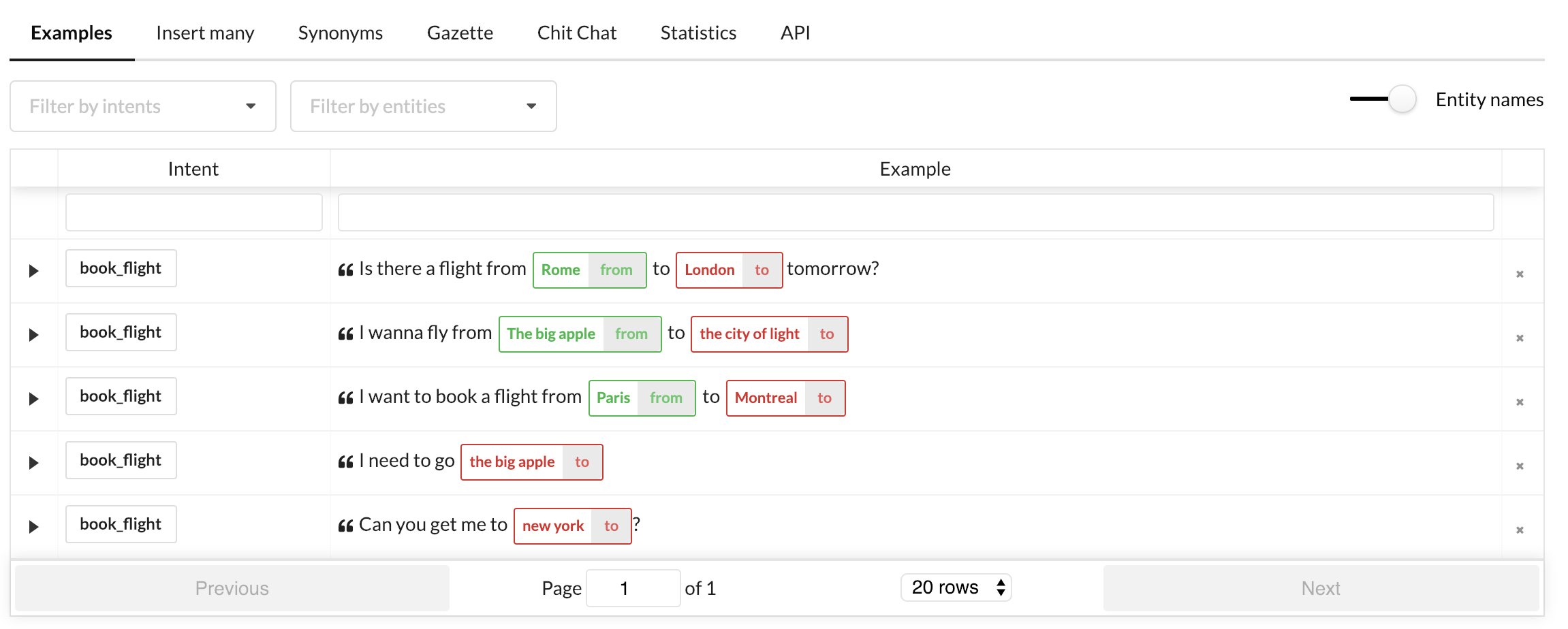
After you train, you can verify if it works as expected or not by typing a sentence in the User says... section. You can see that the from and to entities are picked up as expected.

NOTE
You don't see an intent here because our dataset only has one intent. You need at least two intents to train an intent classifier.
# Entity synonyms
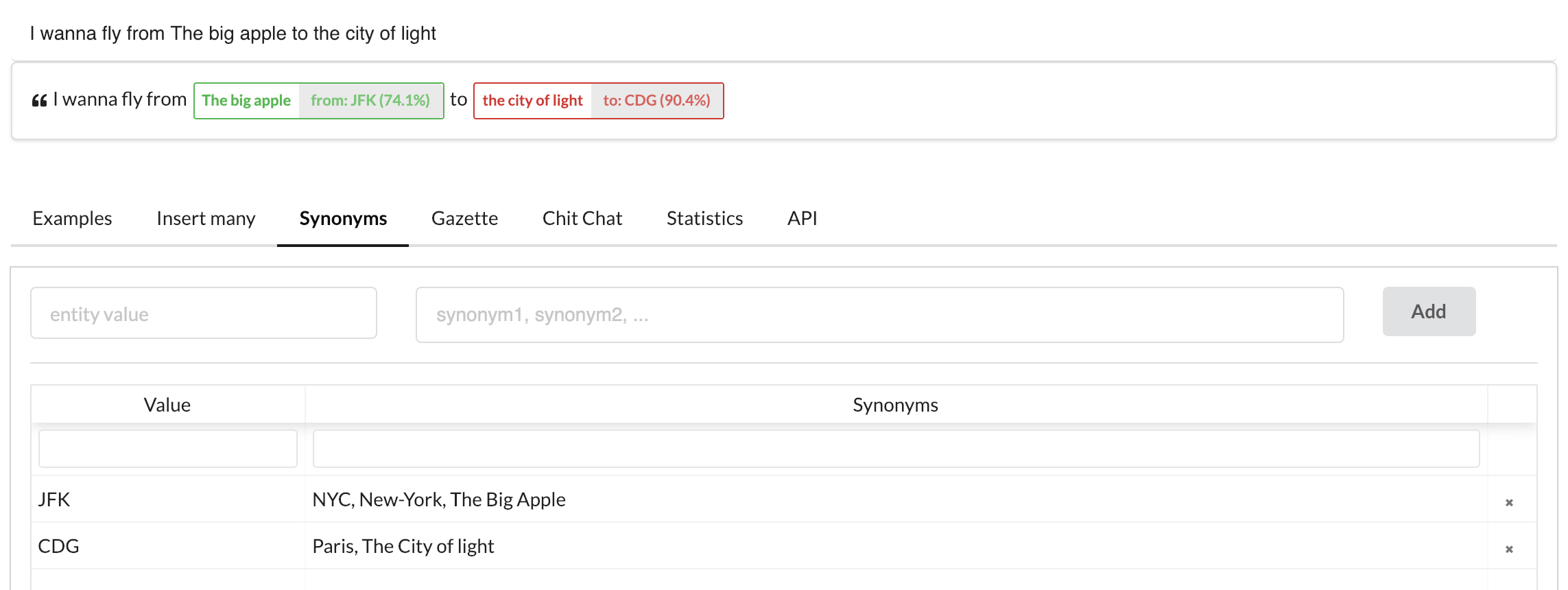
In the example above, if we really want to pass it to a booking engine or a price comparator, we may need airport codes. Entity synonyms could be used for that. In the example below, we mapped the city of light to CDG and The big apple to JFK in the synonyms, retrained, and the values returned for the entities were CDG and JFK.
TIP
Adding synonyms in the table is generally not enough. You still need to teach the entity extractor the various forms an origin or a destination could take by adding more examples to the training data.
We still assume that our users are careful enough to avoid typos and spelling mistakes. Synonyms won't help the model figure it out that the the big aple is JFK or that the citi of lite is CDG.
However, a fuzzy gazette can.
# Gazettes
Gazettes are useful when you expect the values of an entity to be in a finite set, and when you want to give users some spelling latitude. Common examples are colors, brands, or cities.
In the example below we want to make sure the color entity returns an allowed color. The allowed colors are red and blue. We want to be sure of two things:
- If the
CRFEntityExtractorextracts yellow, which is not in the whitelist, we don't want it in the NLU parse data. - The correct color is returned if the user spells it incorrectly (to some extent).
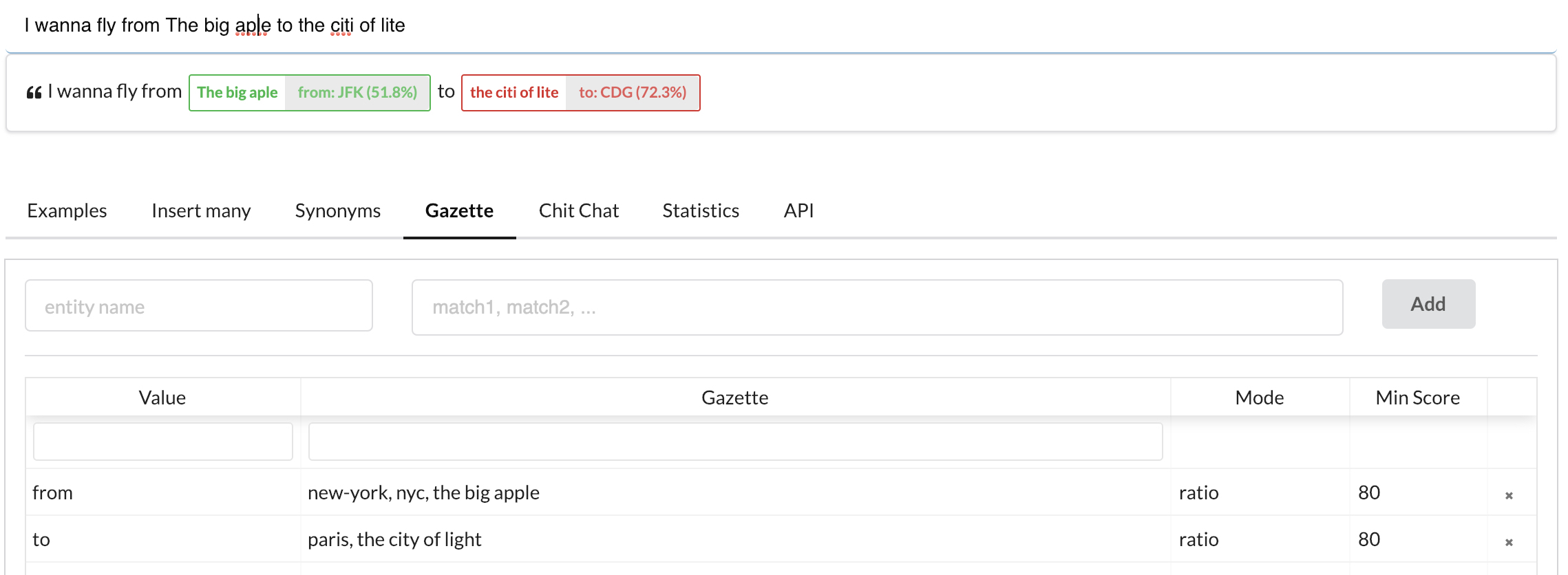
All you have to do is to specify the list of allowed (or commonly) expected values (there aren't that many ways of saying Paris or New York). The spelling latitude is adjusted with the fuzziness parameter. 100 will have no telerance to errors, 0 will be extremely tolerant. It will always return one of the values even if the user types something completely out of scope.
NOTE
When the entity extractor picks up citi of lite, it compares it with every element of the Gazette list and computes a fuzziness score for each element. The highest score is for the city of light, which is then mapped to CDG by the synonyms processor. If the highest score is below the minimum score, it means the value is out of scope and the entity is removed.
# Compositing entities
Duckling is an open source parser by Facebook which is able to extract structured entities such as numbers, amounts of money, emails, dates. It can be used by Rasa and is integrated in the Botfront package (when you start Botfront with the CLI, a Duckling container is started)
Being a parser, it is only able to recognize patterns in a sentence and not to attribute them to specific entities. For example, in the following sentence:
I want 2 beers and 3 cokes
Duckling will return two instances of the number entity, but no information about which quantity applies to which beverage.
Luckily, Botfront comes with a component just for that. Simply annotate 2 as a beers_count entity and 3 as a cokes_count entity.
Then add the following component in the pipeline after the CRFEntityExtractor:
- name: CRFEntityExtractor
  ...
- name: rasa_addons.nlu.components.duckling_http_extractor.DucklingHTTPExtractor
  url: http://duckling:8000
  dimensions:
  - "number"

- name: rasa_addons.nlu.components.duckling_crf_merger.DucklingCrfMerger
  entities:
    beers_count: ["number"]
    cokes_count: ["number"]
Now, the beers_count and cokes_count entities are guaranteed to return a value of type number, and your custom actions can safely rely on it. If the CRFEntityExtractor extracts an entity that does not contain a number it is going to be removed.
The order is important
- The entities are first extracted by the
ner_crfcomponent. - Duckling extracts numbers
DucklingCrfMergermerges them. The value ofbeers_countwill be 2
# Configuring the pipeline
For the above to work in our example, we need to make sure things happen in the right order:
- The
CRFEntityExtractorcomponent extracts citi of lite from the utterance - The
Gazettecomponent replaces citi of lite with the city of light - The
EntitySynonymMappercomponenent maps the city of light to CDG.
# Semantic variety
Introducing variety is key to build a capable model.
GOOD
I want to book a flight from Paris to Montreal
Is there a flight from Rome to London tomorrow?
I wanna fly from The big apple to the city of light
The following will only get you so far.
BAD
I want to book a flight from Paris to Montreal
I want to book a flight from Rome to London tomorrow?
I want to book a flight from The big apple to the city of light
# Spelling errors
Spelling errors can affect both entity extraction and intent classification. We have seen above how gazettes can help with typos in entities but we were also lucky that it worked well with only a few examples.
TIP
Your data set must reflect how users talk to your bot.
If your users do spelling mistakes, then your training data should have some too.